I’m still processing this, and I keep grinning every time I think about it. A few days ago, our team of four stood in front of Ajay Banga and walked him through an idea that started as a sketch on a whiteboard almost a year ago, and he told us to go build it. A budget, a year, a mandate to commercialize. The coveted Green Box. Out of hundreds of ideas submitted across every region globally, ours made it all the way through.
Let me back up, because the journey here was wild.
Drew reached out to me earlier this year about an idea that he, Adam, and Ted had been noodling on. Drew and I work together on Simplify Commerce, so I knew exactly what I was getting into: the guy is an idea person, perpetually noodling on at least a dozen concepts at any given time, and he’d seen me in action at various hackathons over the years. So when he pinged me about this one, I knew it was worth a listen. The pitch was a conversational interface for merchant business intelligence, and the moment he laid out the vision, the AI and NLP potential combined with the sheer wealth of data Mastercard sits on drew me in (pun very much intended). I was all in.
The IdeaBox Program
Mastercard runs an internal innovation program called IdeaBox, and the structure is unlike any corporate hackathon I’ve seen. It’s not a weekend sprint where you build something half-baked and demo it on Sunday afternoon. IdeaBox is a “desert-island kit for innovation,” a multi-stage gauntlet that runs across regions, spanning months, with real stakes at each gate. The premise is ambitious: give employees the chance to create their own startup within Mastercard.
The program uses a color-coded box system that represents progressive levels of commitment from the company. The Orange Box is the exploring phase: you get a framework and 60 days to build out your idea into a real pitch, then present it to the IdeaBox Panel. Only the best ideas survive. The Red Box is the building phase, where you move from pitching to actually constructing the product, validating it in the market, and building a business case strong enough to attract executive support, with a $25,000 development budget to back it up. The Green Box is the final stage, the one that felt impossible when we started: full incubation within Mastercard Labs, executive sponsorship, and a mandate to spin out your concept as an internal startup. You move full time to working on your product.
Orange Box: Exploring the Idea
The idea, which we called SmartTalk, was simple to explain and hard to build: a chatbot that gave merchants conversational access to business intelligence powered by Mastercard’s transaction data. Instead of logging into a dashboard and wrestling with filters, a merchant could just ask a question in plain language and get an answer. Mastercard sits on one of the richest transaction datasets on the planet, and most of that insight was locked behind tools that required analysts to extract it. We wanted to put it directly in the merchant’s hands through a conversation.
Our team of four submitted from the NYC and STL offices, competing in a pool that spanned the globe. Hundreds of ideas came in from every Mastercard region, each one backed by people who believed they’d found the next thing. The Orange Box gave us 60 days and a framework to sharpen our concept into something pitch-ready, which is the kind of constraint that forces clarity. You learn to articulate a vision quickly, distill months of thinking into a pitch that lands in minutes.
We pitched to the IdeaBox Panel and made it through. Orange Box, won. That feeling when your name shows up on the shortlist is hard to describe, a mix of relief and pure adrenaline, because you know the next stage is where it gets real.
The idea had legs, validated by a panel, but an idea nonetheless. The real test was whether it could survive contact with actual engineering.
Red Box: Building with Microsoft’s AI Team
Winning the Red Box meant we had permission to stop talking and start building, and this is where things got really fun. Mastercard gave us $25,000 in development budget and the latitude to form a team, and the partnership we landed still makes me smile.
We partnered with Microsoft and flew out to Seattle to work directly with their AI team. Jennifer Marsman led the AI team on Microsoft’s side, and we got to team up with Bill Barnes and his group of exceptional engineers. The core of our NLP layer was Microsoft LUIS (Language Understanding Intelligent Service), which handled the intent recognition and entity extraction that made conversational queries possible. A merchant typing “how did my weekend sales compare to last month?” needed to be parsed into the right data query against Mastercard’s transaction layer, and LUIS was the engine that made that translation work.
The hackathon week at Microsoft was an incredible experience. We were one of many teams from around the world, all hacking alongside each other, sharing breakthroughs and commiserating over bugs. Our week was spent deep in the LUIS integration, fixing bugs in our intent models, and pushing the NLP pipeline toward something that could handle the messy reality of how merchants actually phrase questions about their business. Jennifer’s team and Bill’s engineers were incredibly generous with their time, and the back-and-forth between their deep NLP knowledge and our understanding of the Mastercard data ecosystem is what turned a prototype into something real.
The week in Seattle was where the idea stopped being a slide deck and started being software.
There’s something electric about sitting in a room with a team, fixing bugs together at a whiteboard, arguing about edge cases in how LUIS parses merchant queries, and then watching it actually work. By the end of the week, we had a working chatbot that could field natural language questions and return actual business intelligence from Mastercard’s data, validated in the market with a business case strong enough to attract executive attention. Walking out of Microsoft’s campus that last day, we knew we had something special.
Green Box: The Surreal Part
Winning the Green Box is the part that still feels like a dream.
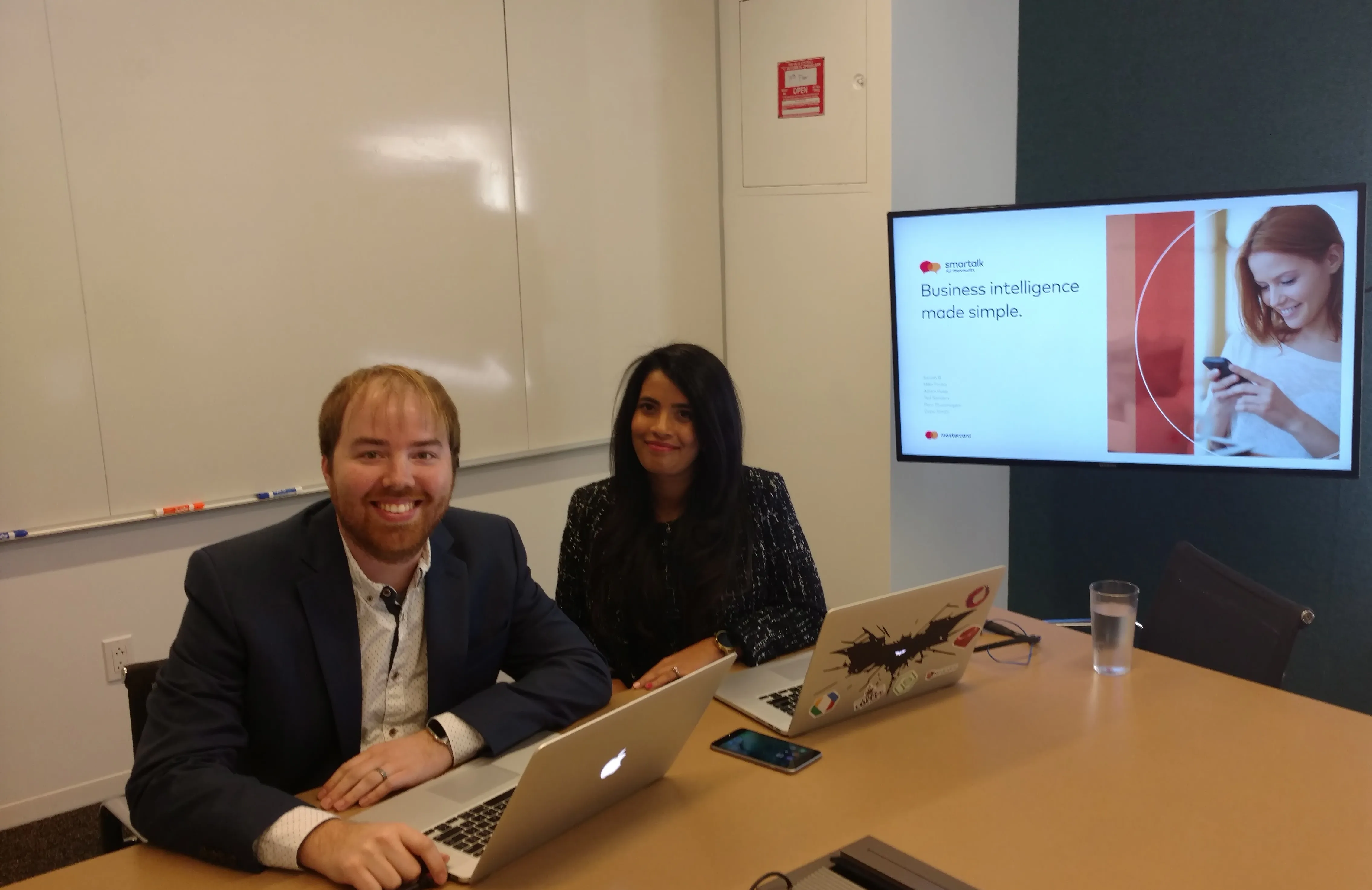
Adam and I right before the pitch to Ajay Banga, with SmartTalk up on the screen behind us. The nerves were real, but so was the excitement.
The Green Box means Mastercard is spinning you out as an internal startup within Mastercard Labs, far beyond a pat on the back. We got to present SmartTalk directly to Ajay, walk him through the product, discuss the roadmap, and lay out what commercialization could look like. He asked hard questions and pushed on the business model, treating it as a real investment decision, but you could tell he was excited about the potential. Then he gave us the green light: executive sponsorship, a budget, a year, and a mandate to go build this full time.
Out of every idea submitted globally, across every region, ours went from a whiteboard sketch to an executive-sponsored product with a commercialization mandate. For a team of four, that trajectory is absolutely wild.
Letting It Sink In
The next steps are still being figured out, and I’m more than fine with that. For now, I’m letting this sink in and savoring what this past year actually was: months of ideation, countless iterations on the pitch, an unforgettable week in Seattle building with Jennifer, Bill, and the Microsoft AI team, a showcase in front of the CEO of Mastercard, and a green light to go build.
Leading the technical vision for this project, from choosing LUIS as our NLP backbone to designing how we’d query Mastercard’s transaction data layer through a conversational interface, has been the most rewarding work of my career so far. Collaborating with this team and watching an idea evolve from a rough concept into something the company wants to invest in, that’s the kind of work that reminds you why you got into engineering in the first place. The past year has been one long exercise in bringing something to fruition, and the best part? The real work is just starting, and I can’t wait.